
Jack Taylor|Jun 12, 2026
Do you want to get notified when new software or services are added to Krowdbase? Sign up for our newsletter and stay ahead with the latest tools, providers, features, and updates.

Oct 13, 2026
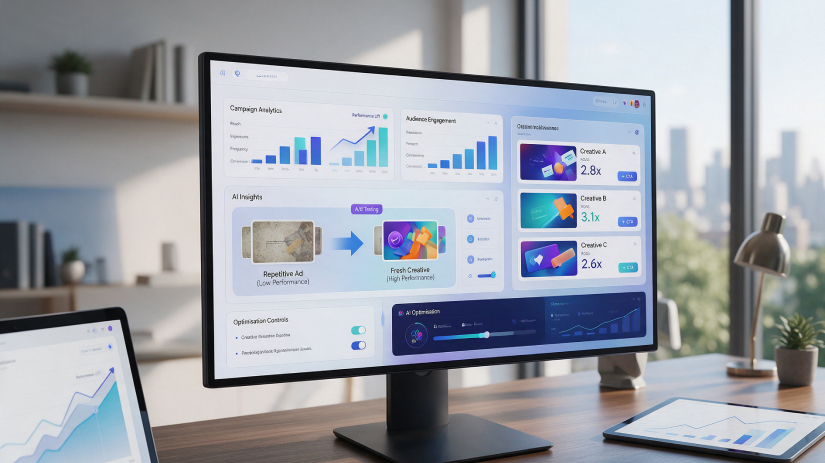
Everyrates climb, and conversions look promising. Then the numbers start sliding. The creative hasn’t changed, and the targeting is still tight, but the audience has stopped paying attention. That’s ad fatigue, and it’s one of the most persistent drains on campaign return on investment (ROI). A growing category of AI-powered platforms now tackles fatigue head-on, automating creative variation, intelligent rotatio performance marketer knows the feeling. A campaign launches strong, click-through n, and predictive decay alerts.
Platform | Why It’s Essential | Core Use Cases and Features | Best for | Pricing Model |
1. Realize | Reduces ad fatigue by dynamically rotating creatives and optimizing delivery across open-web inventory. | AI-driven creative refresh, placement diversification, audience expansion. | Performance advertisers scaling campaigns without creative burnout. | Performance-based model; campaigns billed on CPC basis, or CPM for programmatic. |
2. Pencil | Generates large volumes of scored creative variations. | Multi-model AI generation, predictive performance scoring, brand guardrails. | Teams needing constant creative refresh. | SaaS ($14-$299+/month) |
3. VidMob | Identifies creative fatigue patterns through element-level performance analytics. | Creative analytics, predictive scoring, AI-powered tagging engine. | Brands optimizing with data-driven insights | Custom enterprise. |
4. Smartly.io | Scales creative production and rotation across paid social channels. | AI Studio, dynamic creative templates, predictive budget allocation. | Enterprise social advertisers. | Percent of ad spend. |
5. Hunch | Automates dynamic creative variation using product feeds. | Feed-driven creative automation, contextual triggers, hyper-local campaigns. | E-commerce advertisers. | SaaS ($2,000-$2,500/month). |
Automates rules to pause fatigued ads and scale fresh creatives. | Custom automation rules, auto-post boosting, bulk ad management. | Agencies managing multiple campaigns. | SaaS ($49+/month). | |
7. Canva | Enables fast, low-cost creative refresh cycles. | Magic Design, one-click resize, text-to-image generation. | SMBs and in-house teams. | Freemium; Pro from $10/month; Teams from $10/user/month (3-seat minimum). |
Realize targets audience burnout by transforming open-web ad delivery from a repetitive guessing game into a responsive creative framework. Connecting media buyers to a vast ecosystem of over 11,000 premium publisher environments via hard-coded integrations, the platform bypasses the bloated programmatic bid streams that often hammer the same users with identical creatives. This direct architecture ensures that as prospects move across top-tier editorial layouts on networks like Yahoo and MSN, your campaign maintains the agility needed to keep messaging fresh, contextually relevant, and impact-driven.
When fighting ad fatigue, performance teams rely on Realize to automate creative rotation before performance metrics begin to decay. Rather than waiting for click-through rates to collapse before stepping in, advertisers deploy the platform to analyze live interaction, contextual signals, and conversion velocity simultaneously. The underlying algorithmic engine handles the mechanical heavy lifting, constantly matching different messaging structures to real-time content engagement levels and automatically shifting delivery toward the freshest asset variations to ensure user attention remains high.
This platform offers strategic leverage for the likes of mid-market consumer electronics brands, high-growth direct-to-consumer (D2C) subscription apparel lines, and competitive digital wellness apps, who must cycle through an enormous volume of creative assets to maintain their acquisition velocity. If your marketing operation runs aggressive, large-scale budgets and finds that your media buyers are wasting hours copy/pasting slight adjustments to combat diminishing returns on search or social feeds, Realize functions as an automated design assistant. It empowers lean teams to deploy a self-optimizing stream of platform-compliant visual variations across the web, without driving up internal agency or graphic design overhead.
Pricing model: Performance-based model; campaigns billed on cost-per-click (CPC) basis, or cost per mille (CPM) for programmatic.
Why it’s essential: Creative production bottlenecks are a leading cause of ad fatigue — not because advertisers want to run stale assets, but because they can’t produce new ones fast enough. Pencil functions as an AI creative operating system that generates variations and assigns each a predictive performance score before any budget is spent. The platform integrates multiple generative AI models — including OpenAI, Adobe Firefly, and Runway — pulling from whichever produces the strongest result per format. Teams can generate 50 or more variations from a small input set and prioritize the highest-confidence options for launch.
Best for: D2C and e-commerce teams spending more than $50,000 monthly on paid social, and agencies managing multiple client portfolios.
Pricing model: SaaS; plans range from a basic $14-a-month tier up to $299 a month for growing teams to custom enterprise pricing for large-scale brands.
Predictions aren’t guarantees: Live validation is still necessary.
No native competitive intelligence: Pencil analyzes your own data and historical benchmarks but lacks built-in competitor ad libraries or market intelligence tools, which means external creative research is still required to inform your input strategy.
Entry-level generation caps: The lowest-priced tiers heavily throttle monthly generations (capped at 50 for the base plan), forcing high-volume D2C brands and agencies into the premium tiers.
Why it’s essential: Most fatigue tools produce more creatives or distribute them differently. VidMob approaches the problem analytically, using AI to deconstruct why creatives falter and which specific elements drive the decline. Its proprietary vision models automatically tag hundreds of visual, audio, and pacing components across static and video assets, correlating each with downstream performance metrics across 13 integrated ad platforms. Teams can make smaller refreshes rather than wholesale replacements.
Best for: Enterprise brands and agencies managing large creative libraries who need data-driven refresh guidance, not just more volume.
Pricing model: Custom enterprise pricing based on asset volume and integrations.
Why it’s essential: Smartly.io consolidates creative production, media buying, and analytics into a single enterprise platform for high-volume paid social across Meta, TikTok, Pinterest, Snapchat, and connected TV (CTV). Its AI studio has generated more than 1.9 million assets for more than 260 customers, delivering 30 times the production speed and an average 27% performance lift over static creatives. Dynamic templates pull in product data, localized messaging, and audience variables to generate personalized variations from a single master design, while predictive budget allocation automatically redirects spend away from fatiguing assets.
Best for: Enterprise brands and agencies managing more than $100,000 each month across multiple paid social and CTV platforms.
Pricing model: Percentage of ad spend (typically 1%–3%) with enterprise platform minimums starting around $4,000 to $5,000 a month.
Why it’s essential: Hunch zeroes in on keeping catalog-driven creatives fresh across large product inventories and multiple markets. Its dynamic creative optimization (DCO) engine layers product feed data onto customizable templates, generating personalized variations with localized messaging, real-time pricing, and contextual triggers like weather or countdown timers. A recognized Meta Business Partner, the platform has processed more than 200 million automated ads, and its particular strength is geo-targeting workarounds and localized dynamic product ads.
Best for: E-commerce advertisers and retail brands managing large catalogs across multiple regions.
Pricing model: SaaS model based on managed ad spend, starting at $2,000 a month (billed annually) or $2,500 month-to-month for enterprise-level teams.
Bïrch (formerly Revealbot) uses rule-based logic where advertisers define exact conditions for pausing ads, shifting budgets, and firing alerts — such as “if frequency exceeds 3.0 and click-through rate (CTR) drops below 1.5%, pause and notify via Slack.” The platform processes more than 2.3 million rule executions daily across Meta, Google, TikTok, and Snapchat.
Best for: Agencies and experienced media buyers who want transparent, systematic automation rather than black-box AI.
Pricing model: SaaS with an Essential plan starts at $49 per month, while the Pro tier (which unlocks automation rules) starts at $99 per month and scales based on total monthly ad spend.
Why it’s essential: Canva isn’t a performance advertising platform. It doesn’t monitor metrics or automate rotation. What it does is lower the cost and speed barrier for producing refreshes. Its template library, AI design tools, and one-click resizing let non-designers produce platform-ready ad assets in minutes.
Best for: Small and medium-sized businesses (SMBs) and in-house teams with limited design resources needing quick, affordable refreshes.
Pricing model: Freemium; Pro (individual) is $15 a month (or $10 a month when purchased annually); team plans start at $10 per month per user with a minimum of three seats ($30 per month total baseline).
The most effective approach to ad fatigue combines tools aligned to different parts of the problem. Production platforms (Pencil, Canva) keep the asset pipeline full, analytical tools (VidMob) identify what’s causing fatigue, Realize automates rotation across the open web, and orchestration tools (Smartly.io, Bïrch) coordinate budget and timing. No single platform does all of it, but the right combination — matched to your budget, channel mix, and team capacity — keeps performance climbing long after unmanaged campaigns would have plateaued.