Arina|Oct 24, 2026
Do you want to get notified when new software or services are added to Krowdbase? Sign up for our newsletter and stay ahead with the latest tools, providers, features, and updates.

Oct 14, 2026
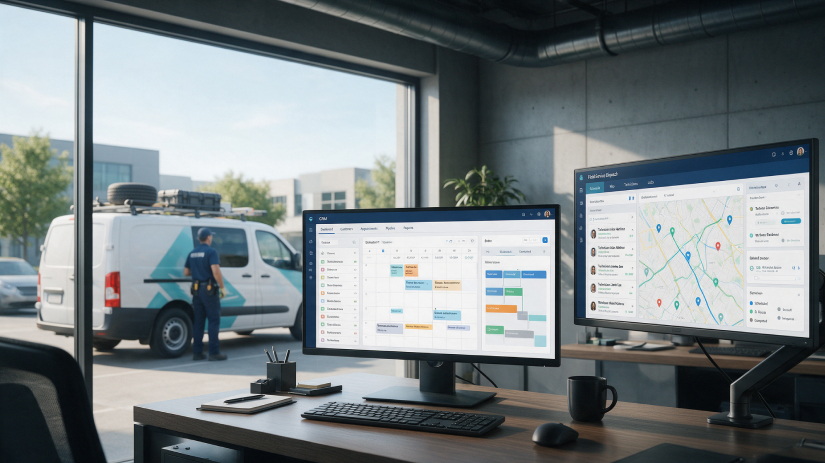
HighLevel needs a dedicated field service layer because a CRM and a field operation run on different data, different users, and different timelines. GHL organizes everything around contacts and conversations. Field work, on the other hand, revolves around jobs, locations, routes, and hours.
Trying to force both into one structure creates friction for everyone. Office staff build workarounds, technicians ignore the system, and owners lose visibility. A dedicated field service layer solves this by letting each system do the job it was designed for.
HighLevel is a good CRM, but it doesn’t have all the features to manage field services.
FieldTask is the only dedicated FSM exclusively built for HighLevel.
People trying to use HighLevel as the CRM+FSM without FieldTask won’t be possible.
It syncs natively with the data from GHL.
In this article, I explain why that separation matters, what a proper field service layer includes, and how FieldTask adds it to GoHighLevel without disrupting your existing setup.
A field service layer is the part of your business system that manages work outside the office. It sits on top of your CRM and takes over once a customer books. Its job is to move people, track progress, and record results.
Think of a home service business as two connected floors. The top floor handles marketing, sales, and customer relationships. The ground floor handles trucks, tools, crews, and job sites.
GHL runs the top floor extremely well. The ground floor, however, needs its own structure. That structure is the field service layer.
GHL centers everything on the contact record. Every text, email, appointment, and pipeline stage connects to a person. That makes perfect sense for marketing and sales.
Field operations center on the job instead. A single customer might have five jobs a year, each with its own technician, address details, photos, and hours. When jobs live inside a contact-first system, that detail gets buried.
A CRM tracks what was said and when. Field operations track where people are and how they move. Dispatchers need to know which technician sits closest to a new call, not just who replied last.
That location data requires tools a CRM doesn't usually provide, such as GPS awareness, geofencing, and route planning. Without them, dispatch turns into educated guessing.
GHL serves office staff, sales reps, and marketers who work at desks. Field crews work from trucks, attics, rooftops, and crawl spaces. They need large buttons, fast job lists, and quick photo uploads, not pipeline views.
In my experience, this is the most overlooked difference. A system that feels great in the office can feel useless on a ladder. When technicians find an app hard to use, they stop using it.
A CRM works mostly with planned time: appointment slots and follow-up schedules. Field operations deal with real time: traffic delays, jobs that run long, and emergency calls that reshuffle the day. A field service layer has to react to those changes in minutes, not hours.
Without a field service layer, the office becomes the layer. Dispatchers, office managers, and owners fill the gap with phone calls, texts, and spreadsheets. That works until the business grows.
Here's what usually breaks first:
That last point hurts the most, in my opinion. GHL's automation engine is one of its biggest strengths. Without field data, it sits idle at the most valuable moment in the customer journey.
HighLevel does the CRM part, and FieldTask does the field management. FieldTask acts as the dedicated field service layer that GoHighLevel doesn't include on its own. Each system stays focused, and data flows between them automatically.
You probably know GHL is best in category for marketing. With FieldTask, it also gets enabled for home service in one unified system. That's why many users call FieldTask the most integrated FSM app for HighLevel.
This approach also respects the work you've already done in GHL. Your funnels, pipelines, calendars, and automations stay exactly where they are. FieldTask simply extends them into the field.
The good thing about FieldTask is that you don't have to set up any manual integration. You just install it from the app marketplace, and FieldTask takes care of the rest. No custom code, no webhook mapping, and no Zapier chains to monitor.
This matters because a field service layer has to be reliable. If the connection breaks, jobs get missed. A native install is a big reason owners describe FieldTask as the most connected home service app for HighLevel.
A dedicated field service layer needs specific tools that a CRM doesn't usually offer. Here's what FieldTask brings to GHL.
Dispatch is the heart of the field layer. FieldTask gives managers one board to assign jobs to a technician or full field crew. The job reaches the tech's phone instantly, along with all the customer details from GHL.
Scheduling organizes every field employee's day. Managers handle shifts, recurring jobs, and last-minute changes in one place. Updates reach the crew right away, so nobody drives to a canceled job.
Route planning and route optimization keep trucks moving efficiently. FieldTask arranges each tradesman's stops in the best order. Shorter drives mean fewer late arrivals and more jobs per day.
Proximity-based job assignment uses location data that a CRM doesn't track. FieldTask matches each new job to the nearest available technician. It's the only system that suggests the best techs, which makes emergency dispatch fast and fair.
Crew members upload before and after photos straight to each job. These work photos stay organized by job, not buried in text threads. They protect you in disputes and give your GHL marketing real proof of quality.
The field layer keeps customers informed during the part of the journey GHL can't see. Clear updates between booking and arrival reduce no-shows and calm anxious homeowners.
The "On my way" text alerts customers when the technician starts driving. It gives them time to unlock the gate, park the car elsewhere, or secure pets. In my view, it's one of the cheapest ways to earn better reviews.
A geofence records when staff members enter and leave a job site or office. It replaces manual check-ins with automatic, location-based records. Managers see real arrival times without making a single call.
FieldTask works as a time clock app for HighLevel. Field employees clock in and out from their phones, and geofencing helps confirm they're on site. Owners finally get dependable hours inside the GHL ecosystem.
FieldTask turns those hours into timesheets and calculates payroll automatically. This removes weekly spreadsheet work and reduces costly mistakes. Crew members can view their own hours, which cuts pay disputes.
HighLevel isn’t a good FSM on its own because it was built to win customers, not to run field work. Its calendars, pipelines, and automations handle everything up to the booking very well. After the booking, the tools a field operation depends on aren’t there.
Here’s what’s missing when you try to run field service in GHL alone:
HighLevel becomes a good FSM when FieldTask is added as its field service layer. FieldTask is built only for HighLevel and fills each gap listed above, while GHL keeps doing what it does best.
Here’s what changes after you add FieldTask:
HighLevel needs a dedicated field service layer because CRM work and field work follow different rules. GHL thinks in contacts and conversations, while field operations think in jobs, locations, and hours. Forcing one system to do both leaves gaps that your office has to fill manually.
The FieldTask GHL home service app fills those gaps by acting as that dedicated layer. HighLevel keeps doing the CRM part, and FieldTask handles the field management. In my view, that clean separation is what turns GoHighLevel into a true home service system.
GHL is built around contacts, conversations, and marketing. Field service requires job-based records, location awareness, route planning, and time tracking, which need a dedicated system.
A field service layer is the part of your business system that manages work outside the office. It handles dispatch, scheduling, routes, job documentation, and crew hours.
FieldTask is the most integrated Field Service Management app for HighLevel. It installs from the GHL marketplace and adds a complete field layer without manual integration.
No. Your funnels, pipelines, and automations stay in GHL. FieldTask extends them into the field and sends job results back.