Shopware
An enterprise-grade commerce platform, so you can build the extraordinary. It's flexibility without compromise. Want to learn more
What is Shopware?
Shopware is a modern eCommerce software platform designed to help businesses create, manage, and scale online stores through a flexible, API-first architecture. Built for retailers, manufacturers, wholesalers, and enterprise organizations, Shopware enables businesses to deliver engaging digital shopping experiences across multiple sales channels while supporting long-term growth.
As online commerce continues to evolve, businesses require eCommerce platforms that offer flexibility, customization, automation, and seamless integrations. Traditional eCommerce systems often struggle to adapt to changing customer expectations, omnichannel selling, and complex business operations. Shopware addresses these challenges by providing a scalable commerce platform that combines storefront management, product catalog management, customer experience tools, order processing, and business automation within a unified ecosystem.
One of Shopware's key strengths is its composable commerce approach, allowing businesses to customize their online stores according to specific requirements while maintaining excellent performance and scalability. Whether launching a new online store, managing multiple sales channels, or expanding internationally, Shopware provides the tools needed to support modern digital commerce strategies.
Today, Shopware is widely used by retailers, B2B businesses, manufacturers, distributors, agencies, and enterprises looking for an advanced eCommerce software solution capable of supporting both B2C and B2B commerce.
About Shopware
Shopware is a cloud-based and self-hosted eCommerce software platform that enables businesses to build, manage, and optimize online stores for customers worldwide. The platform combines commerce management, content management, product information management, customer experience tools, marketing capabilities, and business integrations into a single solution.
Unlike traditional online store builders that focus primarily on storefront creation, Shopware provides a highly flexible commerce ecosystem built around API-first development and composable commerce principles. Businesses can customize every aspect of the shopping experience while integrating third-party applications, payment gateways, shipping providers, ERP systems, and CRM software.
Shopware supports businesses of all sizes, from small retailers launching their first online store to global enterprises managing multiple storefronts and international operations. Its modern architecture, scalability, and extensive developer ecosystem make it a preferred solution for organizations seeking complete control over their digital commerce strategy.
With features that support omnichannel selling, personalized customer experiences, automation, and international commerce, Shopware continues to be one of the leading eCommerce software platforms available today.
Key Objectives of Shopware
Simplify Online Store Management
Shopware helps businesses manage products, customers, orders, promotions, and digital storefronts from a centralized platform.
Deliver Exceptional Shopping Experiences
The platform enables businesses to create personalized and engaging customer journeys across multiple digital touchpoints.
Support Omnichannel Commerce
Shopware allows organizations to sell through websites, marketplaces, mobile devices, social platforms, and additional sales channels.
Increase Business Efficiency
Automation tools reduce manual processes related to inventory, order processing, pricing, and customer management.
Enable Global Expansion
Businesses can manage multiple currencies, languages, tax rules, and international storefronts from a single platform.
Provide Scalable Commerce Infrastructure
Shopware supports business growth through flexible architecture that adapts to increasing traffic, product catalogs, and operational complexity.
Primary Category
eCommerce Software
Shopware primarily belongs to the eCommerce Software category. The platform enables businesses to build, manage, customize, and scale online stores while supporting digital commerce operations, customer engagement, and multi-channel selling.
Primary Category
Secondary Categories
Shopware extends beyond online store management by offering content management, B2B commerce, omnichannel selling, marketing automation, and digital experience capabilities.
Secondary Categories
- Augmented Reality Software
- Virtual Reality (VR) Software
- B2B eCommerce Platform Software
- Customer Engagement Software
- Data Analysis Software
- Enterprise Search Software
- Headless eCommerce Software
- KPI Software
- Multi-Channel eCommerce Software
Key Features of Shopware
Storefront Management
Shopware enables businesses to build responsive and visually engaging online storefronts using customizable themes, drag-and-drop content management, and flexible design tools. Businesses can create unique shopping experiences without compromising performance or scalability.
Key Capabilities Include:
- Responsive storefronts
- Theme customization
- Drag-and-drop page builder
- Shopping experience management
- Mobile optimization
- Landing page creation
- CMS functionality
- Brand customization
Product Catalog Management
The platform provides centralized product management tools that simplify organizing, updating, and publishing products across multiple storefronts and sales channels.
Key Capabilities Include:
- Product management
- Category management
- Product variants
- Digital products
- Bulk editing
- Product attributes
- Inventory visibility
- Product media management
Order Management
Shopware streamlines order processing from purchase to fulfillment. Businesses can monitor orders, manage returns, update statuses, and improve operational efficiency through automated workflows.
Key Capabilities Include:
- Order processing
- Return management
- Shipment tracking
- Order history
- Status updates
- Customer notifications
- Workflow automation
- Fulfillment management
Customer Experience Management
The platform helps businesses deliver personalized shopping experiences through customer segmentation, promotions, personalized recommendations, and targeted content.
Key Capabilities Include:
- Customer segmentation
- Personalized shopping
- Promotions
- Customer accounts
- Wishlist functionality
- Loyalty support
- Shopping experiences
- Customer engagement
Multi-Channel Selling
Shopware supports selling across multiple online channels, enabling businesses to reach customers through websites, marketplaces, social commerce, and additional digital platforms.
Key Capabilities Include:
- Omnichannel commerce
- Marketplace integrations
- Social selling
- Centralized management
- Unified inventory
- Sales channel management
- Multi-store support
- Channel synchronization
B2B Commerce Features
Businesses serving wholesale customers can leverage Shopware's B2B capabilities, including custom pricing, company accounts, approval workflows, and bulk ordering.
Key Capabilities Include:
- Company accounts
- Custom pricing
- Quote management
- Bulk ordering
- Approval workflows
- Purchase lists
- Account management
- B2B storefronts
Marketing and Promotions
Shopware includes marketing tools that help businesses increase conversions through discounts, promotional campaigns, product recommendations, and personalized offers.
Key Capabilities Include:
- Discount management
- Promotional campaigns
- Coupon creation
- Product recommendations
- Cross-selling
- Upselling
- Campaign management
- Customer targeting
SEO and Content Management
The platform provides built-in SEO tools and CMS functionality that help businesses improve online visibility while creating engaging website content.
Key Capabilities Include:
- SEO optimization
- URL management
- Meta tag customization
- Blog management
- Landing pages
- Content creation
- Search optimization
- Rich content support
API-First Architecture
Shopware's API-first approach enables businesses to integrate external applications and develop customized commerce solutions.
Key Capabilities Include:
- REST APIs
- Headless commerce
- Custom integrations
- Developer flexibility
- Composable commerce
- Third-party connectivity
- Scalable architecture
- Extension support
Analytics and Reporting
Shopware provides reporting tools that help businesses monitor sales performance, customer behavior, product trends, and operational metrics.
Key Capabilities Include:
- Sales reporting
- Customer insights
- Revenue analytics
- Product performance
- Inventory reporting
- Business dashboards
- Conversion analysis
- Performance tracking
Benefits of Using Shopware
Scalable Commerce Platform
Businesses can expand operations without migrating to a different platform.
Flexible Customization
API-first architecture enables extensive customization for unique business requirements.
Better Customer Experiences
Personalized shopping journeys improve engagement and customer satisfaction.
Omnichannel Selling
Organizations can manage multiple sales channels through a centralized platform.
Improved Business Efficiency
Automation reduces manual effort across inventory, orders, and customer management.
Enterprise-Ready Performance
Shopware supports growing businesses with reliable infrastructure and modern commerce capabilities.
Integrations of Shopware
PayPal
Supports secure online payment processing.
Stripe
Enables multiple payment options for global customers.
Amazon
Synchronizes products and orders with Amazon Marketplace.
Google Shopping
Helps businesses promote products through Google.
ERP Integration
Connects Shopware with enterprise resource planning systems.
CRM Integration
Synchronizes customer information with CRM platforms.
SAP Integration
Supports enterprise business management workflows.
Additional Business Integrations
Additional Integrations Include:
- Salesforce
- HubSpot
- Microsoft Dynamics 365
- Mailchimp
- Klaviyo
- Google Analytics
- Instagram Shopping
- DHL
- UPS
- FedEx
- ShipStation
- Avalara
- QuickBooks
- Xero
Pros and Cons of Shopware
Pros | Cons |
Flexible and scalable eCommerce platform | Advanced customization may require technical expertise |
API-first and composable commerce architecture | Smaller app ecosystem compared to some competitors |
Supports both B2B and B2C commerce | Initial implementation can take longer for complex stores |
Strong multi-channel selling capabilities | Premium features may increase overall costs |
Excellent customization and developer flexibility | Beginners may face a learning curve |
Built-in SEO and content management tools | Some integrations require third-party extensions |
Supports international and multi-language stores | Enterprise implementations often require experienced developers |
Who Should Use Shopware?
Small Businesses
Shopware is suitable for small businesses that want a professional eCommerce software platform capable of supporting future growth. Businesses can build customizable online stores, manage products efficiently, and deliver engaging shopping experiences without being limited by rigid templates.
Ideal Users Include:
- Online retailers
- Boutique stores
- Startup eCommerce brands
- Direct-to-consumer businesses
- Local retailers expanding online
Mid-Sized Businesses
Growing businesses can use Shopware to manage expanding product catalogs, increasing customer demand, and multiple sales channels. Its scalable architecture enables organizations to add new features, automate workflows, and support higher transaction volumes.
Ideal Users Include:
- Growing retail brands
- Wholesale businesses
- Multi-store retailers
- Manufacturers
- Digital commerce businesses
Large Enterprises
Large organizations benefit from Shopware's composable commerce architecture, API-first development, and enterprise-grade customization. Businesses can integrate ERP, CRM, and other enterprise systems while managing multiple storefronts across different regions.
Ideal Users Include:
- Enterprise retailers
- Global brands
- Manufacturers
- Large distributors
- International commerce businesses
Digital Agencies
Agencies building eCommerce solutions for clients can leverage Shopware's flexibility, customization options, and developer-friendly architecture to create tailored online shopping experiences.
Ideal Users Include:
- Web development agencies
- Digital agencies
- Commerce consultants
- Solution providers
- Technology partners
Shopware Use Cases
Online Store Development
Businesses use Shopware to build responsive, feature-rich online stores that provide seamless shopping experiences across desktop and mobile devices.
B2B Commerce
Manufacturers and wholesalers utilize Shopware for customer-specific pricing, company accounts, quotation management, approval workflows, and bulk ordering.
Multi-Channel Selling
Retailers manage products and inventory across websites, online marketplaces, and social commerce platforms from a centralized dashboard.
International eCommerce
Businesses expand globally by managing multiple languages, currencies, tax configurations, and localized storefronts within a single platform.
Product Catalog Management
Organizations organize extensive product catalogs, variants, pricing, digital assets, and inventory while maintaining consistent product information.
Marketing Campaigns
Marketing teams create promotional campaigns, discounts, personalized offers, and product recommendations to increase conversions and customer engagement.
Headless Commerce
Businesses requiring customized digital experiences use Shopware's API-first architecture to develop headless commerce solutions across websites, mobile apps, and other digital channels.
Enterprise Digital Commerce
Large organizations use Shopware to support complex commerce operations while integrating ERP, CRM, warehouse management, and third-party business systems.
Top Shopware Alternatives
Shopify
Shopify is one of the most popular eCommerce software platforms, offering an easy-to-use online store builder, payment processing, inventory management, and extensive app integrations for businesses of all sizes.
Adobe Commerce
Adobe Commerce (formerly Magento) is an enterprise eCommerce platform known for advanced customization, scalability, and extensive commerce capabilities for large organizations.
BigCommerce
BigCommerce provides cloud-based eCommerce software with multi-channel selling, built-in SEO tools, product management, and enterprise-level scalability.
WooCommerce
WooCommerce is a WordPress-based eCommerce platform that enables businesses to build customizable online stores while leveraging the flexibility of the WordPress ecosystem.
Salesforce Commerce Cloud
Salesforce Commerce Cloud delivers enterprise digital commerce capabilities with AI-powered personalization, omnichannel selling, and customer experience management.
PrestaShop
PrestaShop is an open-source eCommerce platform that offers flexibility, extensive customization, and a large ecosystem of modules for online retailers.
Shopware vs Competitors
Feature | Shopware | Shopify | BigCommerce | Adobe Commerce |
Online Store Builder | ✓ | ✓ | ✓ | ✓ |
B2B Commerce | ✓ | Limited | ✓ | ✓ |
API-First Architecture | ✓ | Limited | ✓ | ✓ |
Headless Commerce | ✓ | ✓ | ✓ | ✓ |
Multi-Channel Selling | ✓ | ✓ | ✓ | ✓ |
Product Management | ✓ | ✓ | ✓ | ✓ |
SEO Features | ✓ | ✓ | ✓ | ✓ |
Enterprise Scalability | ✓ | Limited | ✓ | ✓ |
Best For | Flexible & Composable Commerce | Small Businesses | Growing Businesses | Enterprise Commerce |
Why Choose Shopware?
Modern Commerce Architecture
Shopware is built on an API-first, composable commerce architecture that allows businesses to create flexible and highly customized digital commerce experiences. This approach gives organizations greater control over their technology stack while supporting future growth.
Highly Customizable
Unlike many traditional eCommerce platforms, Shopware enables businesses to tailor storefronts, workflows, customer journeys, and integrations according to their specific operational requirements.
Scalable for Growing Businesses
Whether operating a single online store or managing multiple international storefronts, Shopware provides the scalability needed to support increasing traffic, product catalogs, and customer demand.
Strong B2B and B2C Capabilities
The platform supports both consumer and business commerce, making it suitable for retailers, manufacturers, distributors, and wholesalers seeking a unified commerce solution.
Excellent Developer Ecosystem
Shopware offers extensive APIs, documentation, plugins, and development tools that allow businesses and agencies to build customized commerce experiences.
Supports Omnichannel Commerce
Businesses can manage multiple sales channels, customer touchpoints, and digital experiences while maintaining centralized product and order management.
Frequently Asked Questions
What is Shopware?
Shopware is a cloud-based and self-hosted eCommerce software platform designed to help businesses build, manage, and scale online stores. It combines product management, order processing, customer experience management, marketing tools, and multi-channel selling capabilities within a flexible commerce platform suitable for businesses of all sizes.
What are the key features of Shopware?
Shopware offers online store management, product catalog management, order processing, B2B commerce features, marketing automation, SEO tools, multi-channel selling, API-first architecture, headless commerce capabilities, analytics, and extensive third-party integrations. These features help businesses create engaging shopping experiences while improving operational efficiency.
Is Shopware suitable for small businesses?
Yes. Shopware supports startups and small businesses looking for scalable eCommerce software that can grow with their operations. Businesses can launch professional online stores, manage inventory, process orders, and personalize customer experiences while benefiting from flexible customization options.
Which industries use Shopware?
Shopware is widely used by retailers, manufacturers, wholesalers, distributors, consumer brands, automotive businesses, fashion companies, electronics retailers, healthcare suppliers, and B2B organizations. Any business selling products online can benefit from Shopware's flexible commerce capabilities.
Does Shopware integrate with other business software?
Yes. Shopware integrates with CRM software, ERP systems, payment gateways, shipping providers, marketing automation platforms, accounting software, analytics tools, and marketplace solutions including Salesforce, HubSpot, SAP, PayPal, Stripe, Google Analytics, Mailchimp, QuickBooks, Xero, and many other business applications.
What are the benefits of using Shopware?
Shopware helps businesses improve customer experiences, streamline online store management, automate commerce workflows, expand internationally, support multi-channel selling, manage B2B and B2C operations, and build highly customizable digital commerce experiences that support long-term business growth.
Where can I compare Shopware with other eCommerce software?
If you're evaluating Shopware alongside other eCommerce software solutions, platforms like Krowdbase allow you to compare features, pricing, integrations, customization capabilities, supported workflows, pros and cons, and software categories side by side. This helps businesses identify the most suitable eCommerce platform for their requirements.
Where can I find Shopware alternatives?
Businesses researching Shopware alternatives can explore software comparison platforms such as Krowdbase to discover comparable eCommerce software solutions including Shopify, Adobe Commerce, BigCommerce, WooCommerce, Salesforce Commerce Cloud, PrestaShop and other leading digital commerce platforms.
How do I choose the best eCommerce software?
Choosing the best eCommerce software depends on factors such as business size, product catalog, customization requirements, scalability, integrations, international selling capabilities, budget, and long-term growth plans. Krowdbase helps businesses compare eCommerce platforms based on features, use cases, and business requirements.
Why use Krowdbase for software research?
Krowdbase helps businesses make informed software purchasing decisions by providing detailed software profiles, feature comparisons, use cases, alternatives, competitor analysis, software categories, and buying insights. This enables organizations to evaluate eCommerce software and thousands of other business applications before making an investment.
Conclusion
Shopware has established itself as a powerful eCommerce software platform for businesses seeking flexibility, scalability, and modern commerce capabilities. Its API-first architecture, composable commerce approach, and extensive customization options enable organizations to create unique online shopping experiences while supporting both B2B and B2C operations.
The platform combines storefront management, product catalog management, order processing, customer engagement, marketing tools, analytics, and business integrations into a unified ecosystem that helps businesses streamline digital commerce operations. Whether expanding internationally, managing multiple sales channels, or delivering personalized shopping experiences, Shopware provides the tools needed to support long-term success.
For businesses evaluating modern eCommerce software, Shopware offers an excellent balance of flexibility, performance, and scalability. Comparing Shopware with alternatives such as Shopify, BigCommerce, Adobe Commerce, WooCommerce, and Salesforce Commerce Cloud through platforms like Krowdbase can help organizations identify the solution that best aligns with their digital commerce strategy and growth objectives.
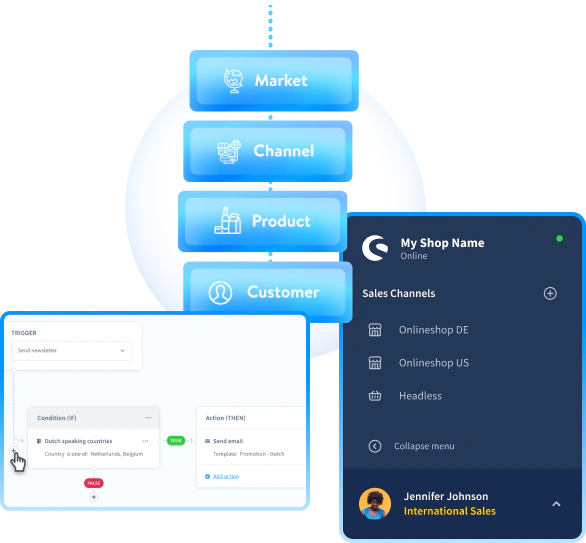
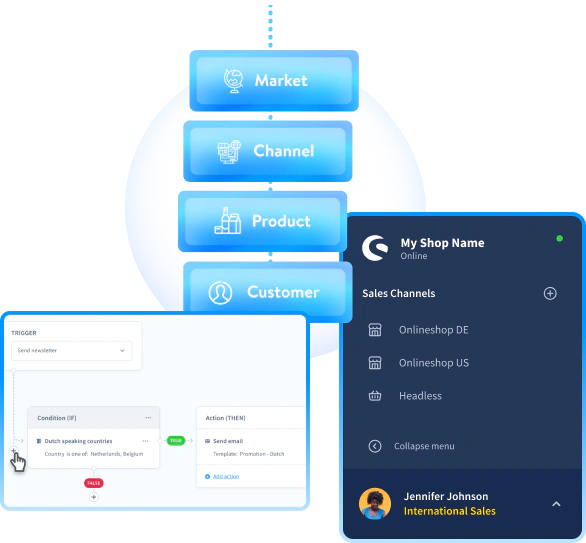
Screenshots
Categories
Features
FAQ
The official website of Shopware is https://www.shopware.com/
Shopware belongs to the Augmented Reality, Virtual Reality (VR), B2B eCommerce Platform, Customer Engagement, Data Analysis, Enterprise Search, Headless eCommerce, KPI, Multi-Channel eCommerce, eCommerce category.
Shopware offers features such as Immersive Environment, Inventory Control, Promotions Management, Data Discovery.
No, Shopware does not offer a free trial.
Need help choosing this software?
Have questions about features, pricing, integrations, or implementation? Send an enquiry to the vendor and get the information you need.
Pricing
Starting at:
$600/per month
Free Trial Available